The second generation of the Focus model, also known as the C-Max compact MPV, was equipped with the 1.8-liter Ford QQDB/QQDA or 1.8 Duratec HE engine, which was assembled between 2003 and 2011. This engine is essentially a replica of the well-known Japanese Mazda MZR L8-DE.
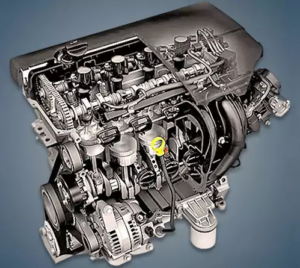
DURATEC HE family:
1.8 L – CFBA, CHBA, QQDB;
2.0 L – AODA, AOWA, CJBA, XQDA;
2.3 L – SEWA, SEBA;
2.5 L – YTMA.
The engine was installed on:
- Ford C-Max Mk1 in 2003 – 2010;
- Ford Focus Mk2 in 2004 – 2011.
Specifications
| Production years | 2003-2011 |
| Displacement, cc | 1798 |
| Fuel system | distributed injection |
| Power output, hp | 125 |
| Torque output, Nm | 165 |
| Cylinder block | aluminum R4 |
| Block head | aluminum 16v |
| Cylinder bore, mm | 83 |
| Piston stroke, mm | 83.1 |
| Compression ratio | 10.8 |
| Features | no |
| Hydraulic lifters | no |
| Timing drive | chain |
| Phase regulator | no |
| Turbocharging | no |
| Recommended engine oil | 5W-30 |
| Engine oil capacity, liter | 4.3 |
| Fuel type | petrol |
| Euro standards | EURO 4 |
| Fuel consumption, L/100 km (for Ford Focus 2005) — city — highway — combined |
9.5 5.6 7.0 |
| Engine lifespan, km | ~350 000 |
| Weight, kg | 102 |
Ford 1.8 Duratec HE reliability
Although the 1.8 Duratec engine is straightforward, there are some issues with it. For instance, intake manifold swirl flaps are necessary for modifications. To reduce oil consumption, this engine frequently requires the replacement of the piston rings. Additionally, the process of modifying the valves’ thermal clearances is extremely expensive.
Rear crankshaft oil seal
Fogging may develop at the block-gearbox junction on Duratec motors, which have a 200,000 km run. Oil leaks in this area are typically caused by the lower bolts of the crankshaft rear oil seal. They simply emerge slightly and allow the oil to flow due to vibrations. In other words, the gland is usually not at fault.
Drive roller and implement belt whistle
During a recall campaign, 1.8 Duratec HE engines replaced a faulty tensioner between early 2008 and mid-2009. Its skewed roller and lack of lubrication caused both the roller’s and the attachment belt’s whistle to be audible.
Floating speed
Owners have been concerned about the 1.8 Duratec engine’s erratic idle speeds and related symptoms, like a slow rpm drop when coasting. If the damper position sensor is operational and these issues persist after flashing and flushing the damper, the damper itself is most likely the source of the issue. Specifically, in the gearbox’s plastic gear wear. Easily remove the servo cover to assess the gears’ play. If there is backlash, there are numerous ways to address the issue, such as changing the damper, printing gears on a 3D printer, or using superglue and soda—a well-liked and incredibly cheap solution—to remove the backlash from worn gears.
A malfunctioning clutch pedal sensor is the cause if the 1.8 Duratec engine speed float stops when the clutch pedal is depressed.
EGR valve
Throttle fouling is thought to be primarily caused by the EGR valve. Disassembling and removing the valve stem is a very simple way to turn it off. After that, they gather and install.
Swirl dampers
The intake manifold has swirl flaps right in front of the intake ports on the cylinder head. At low engine speeds, they are covered. They also cause the air flows entering the cylinders to accelerate. These dampers open at medium and high engine loads.
The flaps hurt. The steel axle’s plastic guides shatter the damper housing’s plastic seats as a result of air pulsations. As a result, the dampers start to rustle, clatter, and stumble violently in their windows when the engine is running. The dampers are obviously the issue if, on a running engine, an unnecessary sound stops when the damper control valve is closed or the vacuum hose is disconnected from the actuator. The swirl flap valve on the Mondeo manifold is situated right next to the actuator. This valve is situated independently on the bar next to a comparable valve that regulates intake geometry on other Duratec engines for Ford, Mazda, and Volvo.
Dampers and plastic guide bushings are sold separately for the Ford Mondeo’s 1.8 Duratec HE engine and its Mazda equivalent. The flaps for the same Ford Focus engine come completely with a manifold, so replacing the flaps with new spare parts to stop the rustle is very costly.
To fix damaged pilot holes or ream holes and install tiny rolling bearings, artisans create PTFE bushings.
Swirl damper control valve
An electro-vacuum valve next to the vacuum actuator drives the swirl flaps’ axis. This type of valve does not ring and frequently fails due to a broken contact in its terminal. A malfunctioning damper valve causes the dampers to stay open all the time, which disrupts mixture formation and causes the engine to react by losing power at low speeds (up to about 2000 rpm) and using more fuel. Additionally, the idle speed can drop significantly after the engine is started, possibly to the point of the engine stopping. A corresponding error indicates an electrical failure of the valve.
Valve train chain
The lamellar timing chain needs to be replaced because of stretching after 200,000–250,000 kilometers of use. It clatters and rustles when the engine is running, just like any chain timing engine. It will not be unnecessary to check the tensioner’s condition when changing the chain on this engine because its rod shouldn’t play. Proactively replacing the front crankshaft pulley is also worthwhile.
Adjustment of valves
Every 150,000 kilometers, the 1.8 Duratec engine’s thermal valve clearances must be changed. Inadequate clearances cause this engine to shake at idle after warming up, fail to start initially, reduce engine thrust, and use more fuel. When valve clearances are not adjusted for approximately 200,000 kilometers, noticeable issues arise. Owners and service members have time to double-check and make any necessary adjustments in an effort to address these symptoms. Adjusting the valves is frequently the final step.
Owners pull with valve adjustment, which is a very costly process on this engine. The engineers’ plan calls for removing the cylinder head, grinding the valves, reassembling the cylinder head, and choosing calibrated pushers.
Increased oil consumption
Every Duratec engine with a 1.8–2.3 liter capacity will eventually require up to a liter of oil per 1000 kilometers. However, a run of roughly 300,000 kilometers with native factory piston rings does not cause this issue on rare specimens. The engine smokes a lot and might not run at its fastest speed when the oil burns.
Coked and stuck oil scraper rings are the source of oil consumption. Furthermore, it has been observed that the stacked oil scraper rings’ expander spring becomes less elastic. Consequently, the oil scraper rings won’t typically press against the cylinders even after the decarbonizer has cleaned them. As a result, oil will be used as waste in a decarbonized engine.
Consequences of catalyst destruction
The cylinders must be examined for wear and ellipse prior to piston ring replacement. The sleeves will often be undamaged.
We also mention that there were instances of cylinder scuffing on Duratec warranty engines as a result of catalyst degradation. In other words, the cylinder mirror was severely worn as a result of ceramic dust entering the cylinders.