From 2004 to 2013, the 1.6-liter Chevrolet F16D3 or LXT engine was assembled in South Korea and fitted to several of the company’s mass models, including the Aveo, Lacetti, and Cruze. In essence, this power unit was an improved Daewoo A16DMS engine.
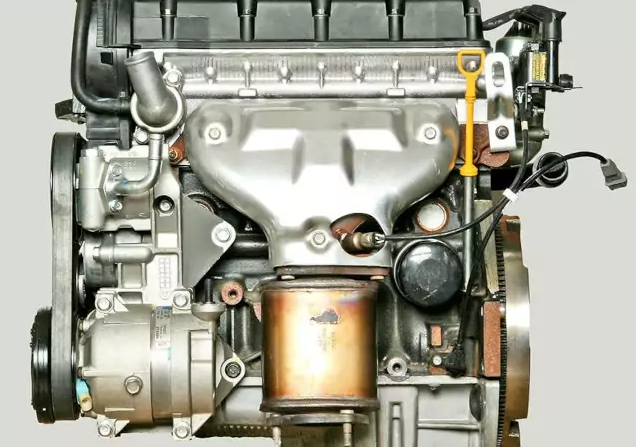
Distributed fuel injection, a cast-iron block for four cylinders, an aluminum 16-valve head with hydraulic compensators, a timing belt, and a plastic intake manifold with a VGIS geometry change system make this engine a classic for the era.
The F series also includes engines: F14D3, F14D4, F15S3, F16D4, F18D3 and F18D4.
Specifications
| Manufacturer | GM DAT |
| Production years | 2004-2013 |
| Cylinder block alloy | cast iron |
| Fuel system | distributed injection |
| Configuration | inline |
| Number of cylinders | 4 |
| Valves per cylinder | 4 |
| Piston stroke, mm | 81.5 |
| Cylinder bore, mm | 79 |
| Compression ratio | 9.5 |
| Displacement, cc | 1598 |
| Power output, hp | 109/5800 |
| Torque output, Nm / rpm | 150/4000 |
| Fuel type | petrol |
| Euro standards | Euro 3/4 |
| Weight, kg | ~112 |
| Fuel consumption, L/100 km (for Chevrolet Lacetti 2006) — city — highway — combined |
9.2 5.9 7.1 |
| Oil consumption, L/1000 km | 0.6 |
| Recommended engine oil | 10W-30 / 5W-30 |
| Engine oil capacity, liter | 3.75 |
| Amount of engine oil for replacement, liter | about 3 |
| Oil change interval, km | 15000 |
| Engine lifespan, km | ~350 000 |
The engine was installed on:
- Chevrolet Aveo T250 in 2008 – 2011;
- Chevrolet Cruze 1 (J300) in 2008 – 2010;
- Chevrolet Lacetti J200 in 2004 – 2013;
- Chevrolet Lanos T150 in 2005 – 2013.
Disadvantages of the F16D3 engine
Because the manufacturer chose the sleeve-valve pair gaps incorrectly, the engines in this series have plates that rapidly accumulate deposits and are unable to fully close. When the soot eventually reaches the valve stem, they just start to hang.
The official regulations state that the timing belt should be replaced every 60,000 kilometers; however, the forums report numerous instances where it breaks even at 30,000 kilometers, which results in a valve bend and a costly repair.
The quick contamination of the intake manifold, which frequently results in a breakdown in the system for altering its geometry, causes a lot of problems for owners of cars with engines of this series. You can shut off the EGR valve if you don’t want to clean the manifold every 10,000 kilometers.
Lambda probes frequently burn out, high-voltage wires serve very little, leaks frequently happen, and lubricant enters the candle wells as a result of a clogged crankcase ventilation system. The oil pump, which is constantly sweating over the gasket, and the thermostat are also weak points.