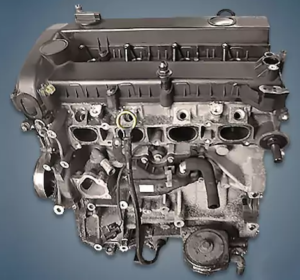
The 2.0-liter Mazda LFF7 gasoline engine was produced by the company from 2004 to 2011 and was installed on the first generation of the Mazda 6 model after restyling and Mazda 5. This power unit was already installed on Ford cars with its own SYDA index.
The L-engine family also includes:
- 1.8 L – L8‑DE, L813;
- 2.0 L – LF‑DE, LF‑VD, LF17, LFF7;
- 2.3 L – L3‑VE, L3‑VDT, L3C1;
- 2.5 L – L5‑VE.
The engine was installed on:
- Mazda 5 CR in 2004 – 2011;
- Mazda 6 I (GG) in 2005 – 2008.
Specifications
| Production years | 2004-2011 |
| Displacement, cc | 1999 |
| Fuel system | distributed injection |
| Power output, hp | 140 – 150 |
| Torque output, Nm | 180 – 190 |
| Cylinder block | aluminum R4 |
| Block head | aluminum 16v |
| Cylinder bore, mm | 87.5 |
| Piston stroke, mm | 83.1 |
| Compression ratio | 10.8 |
| Features | DOHC |
| Hydraulic lifters | no |
| Timing drive | chain |
| Phase regulator | no |
| Turbocharging | no |
| Recommended engine oil | 5W-30 |
| Engine oil capacity, liter | 4.3 |
| Fuel type | petrol |
| Euro standards | EURO 4 |
| Fuel consumption, L/100 km (for Mazda 6 2006) — city — highway — combined |
9.9 5.5 7.1 |
| Engine lifespan, km | ~310 000 |
| Weight, kg | 105 |
Disadvantages of the Mazda LFF7 engine
- A lot of problems can be thrown by eternally sticking intake manifold flaps;
- Due to contamination of the throttle or EGR valve, engine speed often floats here;
- The following also have a low resource: thermostat, pump, lambda probe and unit supports;
- After 200,000 km of run, oil consumption often appears or the chain is stretched;
- There are no hydraulic lifters and valve clearances need to be adjusted every 100 thousand km.