The popular Focus model’s second generation and the C-Max compact van were equipped with the 1.6-liter Ford HXDA engine, also known as the 1.6 Duratec Ti VCT Sigma, which was assembled between 2003 and 2008. Such a unit changed its index to SIDA after a block with an open cooling jacket appeared.
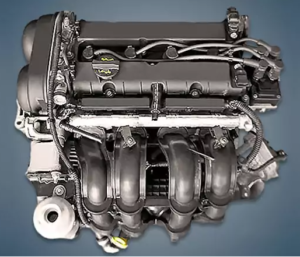
DURATEC Ti-VCT family:
1.5 L – UEJB;
1.6 L – IQDB, HXDA, PNBA, PNDA, SIDA, XTDA.
The engine was installed on:
- Ford C-Max Mk1 in 2003 – 2007;
- Ford Focus Mk2 in 2004 – 2008.
Specifications
| Production years | 2003-2008 |
| Displacement, cc | 1596 |
| Fuel system | distributed injection |
| Power output, hp | 115 |
| Torque output, Nm | 155 |
| Cylinder block | aluminum R4 |
| Block head | aluminum 16v |
| Cylinder bore, mm | 79 |
| Piston stroke, mm | 81.4 |
| Compression ratio | 11.0 |
| Features | no |
| Hydraulic lifters | no |
| Timing drive | belt |
| Phase regulator | Ti-VCT |
| Turbocharging | no |
| Recommended engine oil | 5W-30 |
| Engine oil capacity, liter | 4.1 |
| Fuel type | petrol |
| Euro standards | EURO 4 |
| Fuel consumption, L/100 km (for Ford Focus 2006) — city — highway — combined |
8.7 5.4 6.6 |
| Engine lifespan, km | ~300 000 |
| Weight, kg | 93 |
Disadvantages of the HXDA engine
The majority of owners’ issues are brought on by unreliable phase regulators;
Frequent malfunctions of the fuel pump and ignition system components rank second;
frequent oil leaks from the crankshaft oil seals or beneath the valve cover;
Large maintenance is required once every 100,000 kilometers, including timing replacement and valve clearance adjustment;
You will probably have to deal with the motor’s decarbonization after 200,000 kilometers of operation.